


It was 6 PM stretched into 7 PM. It was dark out. I had no concept of time.
I was hunched over my glowy screen feeling like a god but also like a gremlin. One sip of very cold coffee next to me. A mini whiteboard full of manic scratches of ideas. 117 tabs open. Five Claude Code sessions running at once and me jumping into each one like whackamole the second it loaded.
In a previous post I wrote about finally taking the leap into Claude Code, three sessions running at once on a flight. This was a couple weeks in.
I was addicted, like I was playing videogames. Building multiple things at once. And everything I built made me think of 10 other things I could build. I couldn’t stop the flow. I was exploding with ideas and there wasn’t space to even write everything down.
I felt invincible and incredibly fragmented at the same time. ALIVE but also like a zombie. Burning who knows how many tokens.
And underneath all of it, a lingering inner question.
Why am I doing any of this? What am I actually trying to accomplish here?
Attention is the limit now
Many of those kind of semi-manic building nights made me realize something.
Time is finite. Attention even more so.
Knowledge and data are no longer the limit. Attention is.
The need for focus is more important than it has ever been.
And my happily toxic trait is solving all problems with systems.
So naturally that’s when I built Sylvia OS.
Most of Sylvia OS is just two markdown files
The whole thing lives in a private GitHub repo.

background.md
A memory document. Who am I, what do I care about, what’s my job. It names every stakeholder I work with so the system has full context on my work. I update it whenever the answers change.
journal.md
A forcing function. Monday, Wednesday, Friday I run a command and it interviews me:
→ What’s important right now?
→ What’s stalled?
→ Who am I waiting on?
It kind of forces me to pick what’s important. It’s a super helpful forcing function for my brain.
It also informs the whole system as it runs, so it knows what to prioritize.
The 3 AM routine
Every weekday at 3 AM, a Claude Code routine kicks off in the cloud. Not on my laptop (more on this below).
It looks at every Fireflies call, Slack message, email, and calendar event from yesterday and today. Then:
→ Drafts email responses and saves them as drafts in my Gmail
→ Creates or reschedules Asana tasks based on what’s actually a priority right now
→ Reflects on my previous and upcoming calendar and asks whether the meetings on it are aligned with what I said was important
→ Pulls action items out of my Fireflies calls, so I’m not just saying stuff in meetings and watching the things I committed to fall through the cracks
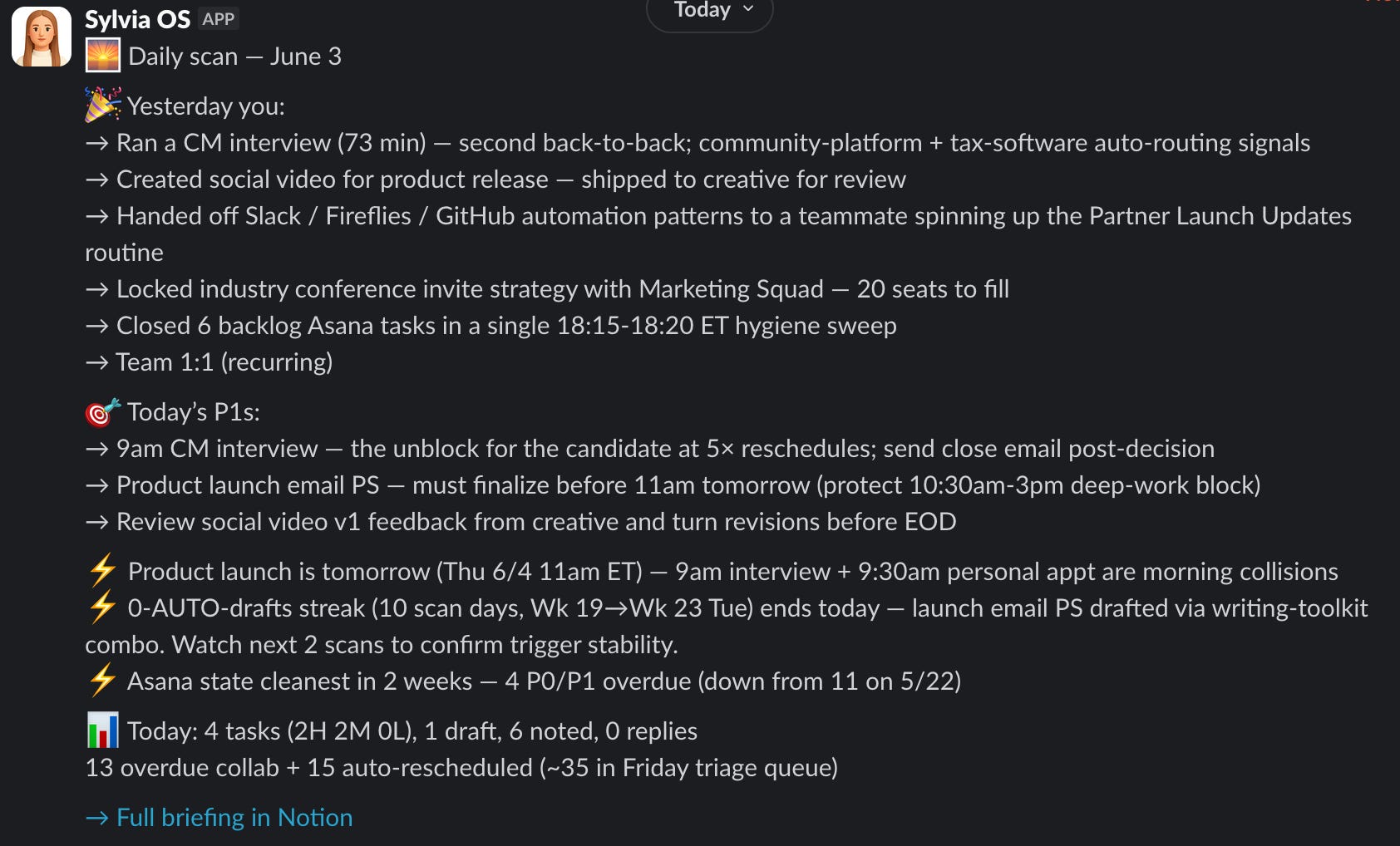
→ Pings me in Slack with a summary from a bot named Sylvia OS
→ Commits a markdown work-log back to GitHub so I can scroll the commits to see exactly what it did
By the time I sit down to work, all the random stuff I committed to on calls and emails and Slacks has been triaged against what I said was important. The work of organizing the work is done (kind of…more on this below).
Unlock #1: Cloud routines run when your laptop is off
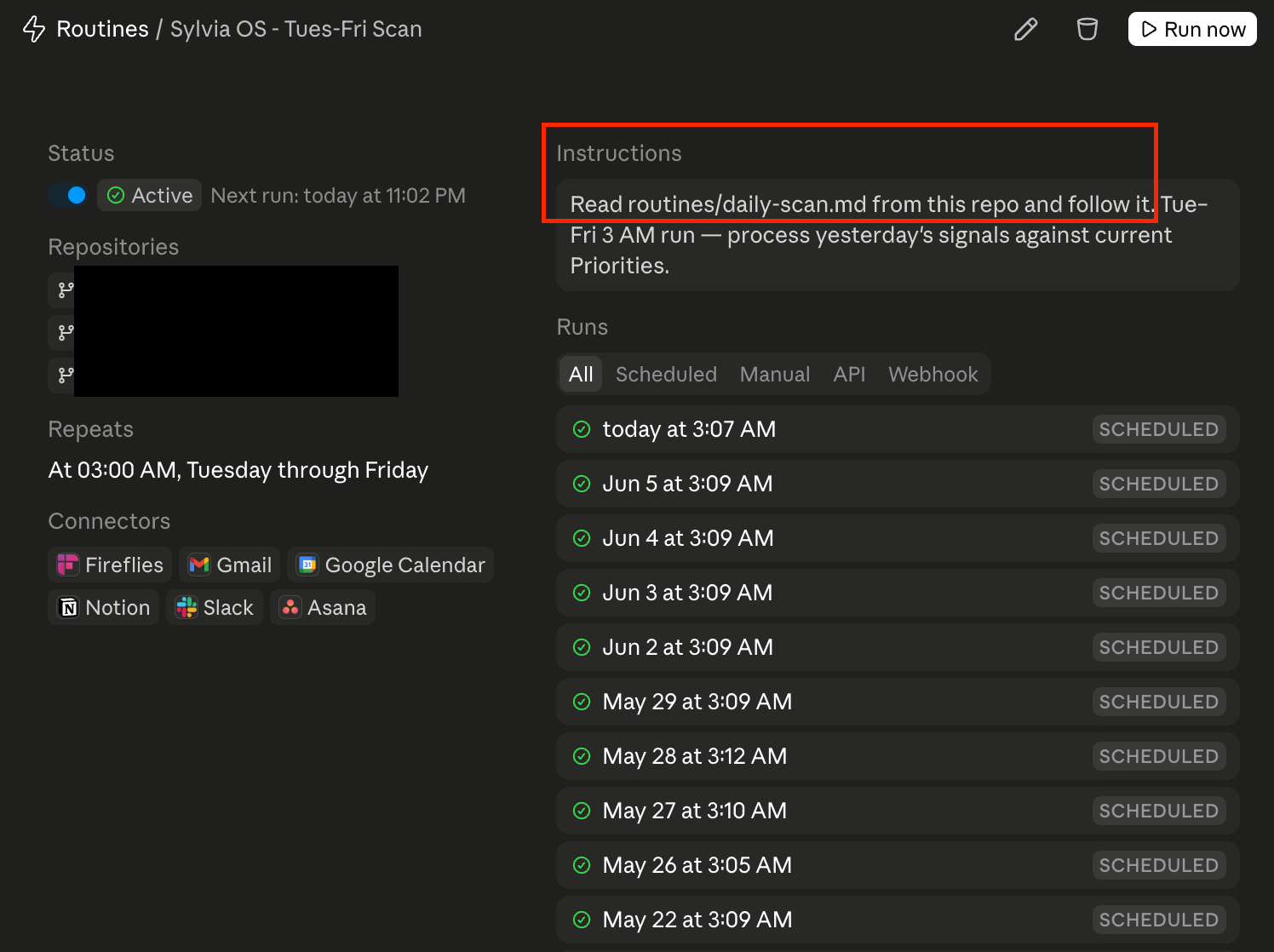
A cloud-based Claude Code routine keeps running while my laptop is off. I sleep. It works. Most of the AI workflows I see people build are local Cowork scheduled tasks, which means they only run when the person is sitting at their machine. The whole game changes when the routine runs without me.

Unlock #2: Routine instructions live in GitHub, not hardcoded in Claude
Most people hard-code their routine instructions inside Claude itself. Mine sit in GitHub. The Claude routine just says “execute the instructions at this GitHub link.” The actual instructions live as markdown files in the brain. When I want to change how a routine works, I edit the markdown file. If something breaks, I roll back to the previous version. I can update all the routines at once if I want, from any Claude Code session. No manual tweaks to hardcoded instructions.
Unlock #3: Why a bot, not my own Slack account
Claude can technically send Slack messages through my own account (you’ll see the “sent using Claude” note on it).
But Slack doesn’t notify you about your own messages. Slacks with no notifications? Super lame and unhelpful.
So I built a custom Slack app named Sylvia OS, gave it the right scopes, invited it to the channels I wanted it in. Now I actually get the ping.
Unlock #4: Notion instead of Google Docs for drafts & editing
A small tool aside. The routine drafts everything into Notion. Claude Code is way better at writing and editing in Notion than Google Docs.
Might be user error, but Claude and Notion are besties.
Notion is where things get edited, commented on, and shared with the team. I honestly prefer Google Docs UI, but I refuse to play the copy/paste game. I also refuse to have it draft local Word docs that I then have to port somewhere else in order to share them.
I not only put first drafts in Notion but I can go back and forth and edit to improve it there too using Claude Code.
Unlock #5: GitHub HTMLs instead of Google Slides
I talked about this in a previous post, but HTML visuals are way better than slides.
AI is a very single-player thing, but the company brain changes that
We also built an incredible GitHub for the whole company.
The Company Brain is the source of truth for everything we do and why.
What’s in it
→ Core product marketing: positioning, pricing, the story
→ Our founder’s manifesto, tying everything back to the big vision
→ A glossary of insider terms I want our team to know, our customers to recognize, and our content to actually use
→ Every department’s strategy doc, so marketing knows what sales is doing and customer success knows what product is shipping without anyone having to align in a meeting
→ HTML strategy visuals we use instead of slides (slides are a pain to make and are generally terrible, and these are quick to build and way better visually) - we have one of these for every major campaign, playbook, launch, etc.
→ Every shared skill, plugin, etc. anyone on the team has built
The front end is our internal wiki
GitHub’s front end is basically a browseable internal wiki. You can pull up the playbook for an upcoming launch. Read what another department is working on. No meeting required. But to be honest, so far I generally don’t actually go into GitHub, I just pull and push information from it using Claude Code.
Who gets to update the brain
Each team picks their own approval rules:
→ Some teams: only the leader of the department updates their section
→ Other teams: everyone can update it
For my team, I wanted everyone on my team to be able to contribute to it. Because one of the things GitHub does best is versioning. If someone pushes something wrong, you can so easily see what it was and roll it back. The risk is so low that I’d rather have more people contributing than fewer. This is meant to be a living, breathing system, not a static system that collects dust.
How it stays current
Some Claude Code routines update the brain automatically. For a launch, I have a daily routine looks at a launch plan and the Slack channel for that launch, and updates the plan based on how things change every day. Example: someone posts that a date has shifted or a new need has surfaced? The visual HTML plan gets updated before the next launch meeting.
I also manually update it often as I’m working. If I see Claude produce something that is out of date I ask it to update the brain so that no one else is working off of outdated info.
Why it works
Everyone uses the same shared brain. Everyone pulls from the same shared knowledge base. That’s how we keep everything sounding like us and aligned to our strategy and why we exist. The brain is the source of truth, so the output stays consistent.
The deeper reason: AI, by default, is a very single-player thing. People will inevitably build cool stuff inside their own ChatGPT or Claude. But there’s no self-improving, continuously improving hub of knowledge for the team to build on top of.
In the olden days, your source-of-truth documentation would more than likely collect dust somewhere and nobody would actually pay attention to it. Now it’s integrated automatically into every project every person is working on, because most of the work is happening in Claude anyway, and Claude is connected to the GitHub brain.
The source of truth is automatically picking up the latest and greatest version of itself, because it’s constantly evolving.
System problems to solve: Now I just have a f*** load of tasks
I’ll be honest about the part I haven’t cracked yet.
Right now the system is creating tasks and organizing my work. Which is beautiful. But all that leaves me with is a bazillion tasks.
What I want next is for it to start working on the work. If there’s a task where there’s clearly a skill that maps to it, just start doing it. Don’t ask. Just put it on my desk for review.
Write the first draft. Create the strategy doc. Make the meeting prep thing.
So far, I haven’t cracked this. I still have to prompt and handhold it on execution. And some days I open Asana to a wall of tasks and just want to close the tab and work off of vibes!
I’m writing about it here because most of the BS “I replaced my whole team with AI” pieces skip the part where you tried something and it didn’t work.
At the end of the day, the problem here is partly that Claude isn’t playing super nicely with Asana (eg sometimes it creates duplicates). The other part of the problem is probably me and that I’m clearly committing to too many things.
Work in progress: Instead of it auto-creating ALL tasks I am adding an approval step where it suggests tasks and then I only create the ones I want.
The work of writing it down is the work
If you’re a first marketer, a founder, an early hire, anyone trying to figure out your own job in this new world, the trap I fell into is the trap everyone is falling into.
There are infinite things you could be doing at any given moment. AI made that 10x more true. Knowledge isn’t the bottleneck anymore. Attention is.
What got me out of the spiral was a brain that evolves with me and changes week by week based on my actual priorities.
A document that knows who I am. A journal that interviews me three times a week to force me to prioritize. A shared brain where my team’s knowledge compounds instead of collecting dust. A routine that does the triage so I can do the creative thinking.
Mine is mostly markdown files in a GitHub repo and a few Claude skills wired into the tools I already use. Building the system was the easy part. Writing down what I knew was harder. Every Monday and Wednesday when it asks me to rank my top three priorities it’s painful. And helpful.
A couple months in, I still get the gremlin nights. Five Claude Code sessions, the whiteboard filling up faster than my hand can move, cold coffee, big dreams. The difference now is what happens in the morning. I wake up and the system has already at least tried to do the work of separating what actually mattered from what was just exciting at 7 PM for 5 seconds.
My happily toxic trait is solving all problems with systems. Some nights it’s the only thing standing between me and full gremlin mode.
This is so helpful- thanks for sharing your journey. and especially the parts you haven't figured out yet because that is REAL. We can all rise together :)