


It was 7 AM on a flight from Miami to Phoenix. Window shades pulled down everywhere. The cabin was dark. The teenager to my right was scrolling TikTok. An elderly woman a few rows up was watching something with a lot of drama and fake tans. The man in the seat beside me was fast asleep, hat pulled over his eyes.
I was in the exit row, aisle seat. Steaming coffee on the tray table. Laptop on my knees.
3 terminal windows open in a vertical layout, horizontally stacked so I could flip between them. Dark mode. Code-y looking text scrolling across the screen.
I was building copy and wireframes for a whole new website. Running a campaign strategy that involved merging 4 messy lists with overlap and missing data. And building a system that would scrape my call transcripts every week, identify topics that would make good LinkedIn posts, and research people in my network talking about similar things to surface what’s hot.
I had made it. I was basically an engineer. And I felt on top of the world.
But here’s the thing about that feeling. It was about 2 weeks old. And before it had been several weeks of something very different.
The Monday night that broke me
Rewind 2 weeks. It was a Monday. I had spent the entire day, and the weekend before it, trying to get a custom GPT to synthesize sales call transcripts for a messaging project. The problem was simple. I needed insights extracted across several categories from about 20 transcripts. The execution was a disaster.
If I gave the GPT even a couple of transcripts at once, it would either hand me back something so vague it was useless or it would hallucinate. I’d double check the output and realize it was making things up. Citing quotes that didn’t exist. Attributing insights to the wrong person.
So I found a process that technically worked. Manually export each transcript. Run it through the GPT with the same prompt. Get it to output into a table format. Copy the table. Paste it into a spreadsheet.
One by one. Row by row. 20 times.
Embarrassingly high value work for a CMO who had grown multiple companies to billion dollar valuations. Real productive.
That night, my phone lit up. A group text with a few women I deeply respect. Powerful execs, close friends. One of them had sent “Guys claude code is nuts. I am creating a super agent over 7 other agents.”
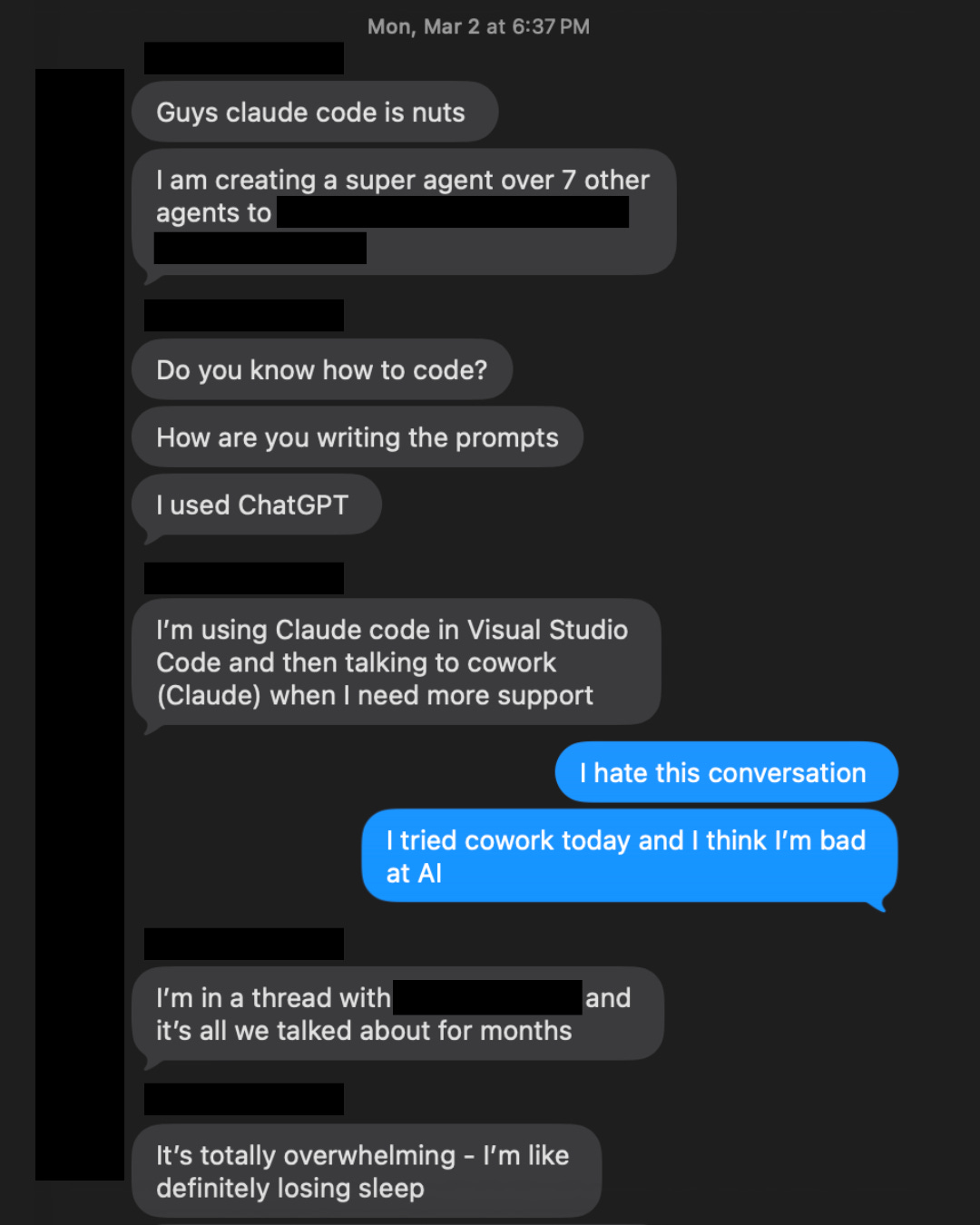
Someone asked if she knew how to code. Someone else asked how she was writing the prompts. She said she was using Claude Code in Visual Studio Code and then talking to Cowork when she needed more support.
Whatever the hell that meant.
I texted back: “I hate this conversation. I tried Cowork today and I think I’m bad at AI.”
Someone responded that they were in a thread where it was all anyone talked about for months. Someone else said it was totally overwhelming, that she was definitely losing sleep.
I tossed my phone across the room and went for a walk. Ignored it the rest of the night.
The thing about feeling behind
I can handle hard things. I’ve moved to 4 cities knowing no one. I’ve been the first marketing hire 3 times, building everything from zero with no playbook and no team.
But something about feeling behind the times hit differently.
I’m obsessed with optimizing myself. Training blocks, habit stacking, sticky notes with priorities. The fact that I knew I had wasted time doing something in a clearly non-ideal way made me furious. Not frustrated. Furious.
Late last year I had left an incredible CMO role at an $850M valued company where I’d been the 4th employee and grown everything from scratch. Part of why I left was because I saw all these AI native companies and I wanted that. I wanted a blank slate. I wanted to be in builder mode with these new tools. I wanted them to make me a superhuman.
And here I was. Pissed at a text from my friends on a Monday night after copying and pasting hundreds of times.
The least productive week that changed everything
The next morning was a Tuesday. My calendar was light. I moved even the few meetings I had.
I was going to figure out this Claude Code thing if it killed me.
Sun streaming in. Biscayne Bay and ocean stretching out beyond the window of my high rise in Miami. Boats going by, a bird or two, jet skis out there. And me, hunched over my laptop like a hacker. Feeling like I’d found the pot of gold at the end of a rainbow.

It was probably one of the least productive days I’d had in a long time. Which led to one of the least productive weeks I’d had in a long time.
And it changed everything. You truly do have to slow down to speed up sometimes. That week was proof.
Context is the unlock
The day before I had tried Claude’s Cowork feature. It made a doc instead of outputting a stream of text.
I was like, whoopdie doo. Who cares. This is pointless.
But that Tuesday I started reading setup guides. Maybe 3 different ones, all saying different things. A couple of them mentioned something important. Every Cowork session starts with zero memory.
Unlike ChatGPT, which decides what to remember about you, Claude lets you build the memory yourself through a file called claude.md.
This was weird for me. I never use local folders or files. People had told me Claude could create Word docs and I was like, ew. I never keep anything locally.
But fine. I made a folder called “claude” on my computer. A fresh empty folder. I happened to have a bunch of docs I’d already made for a Claude project at work: brand brain, voice and tone, insider language, copy formatting guides, current website copy, manifesto, a bank of customer quotes, SEO guidance. I dumped them all in.
Then I pointed Claude at the folder and said: make a claude.md file based on these docs.
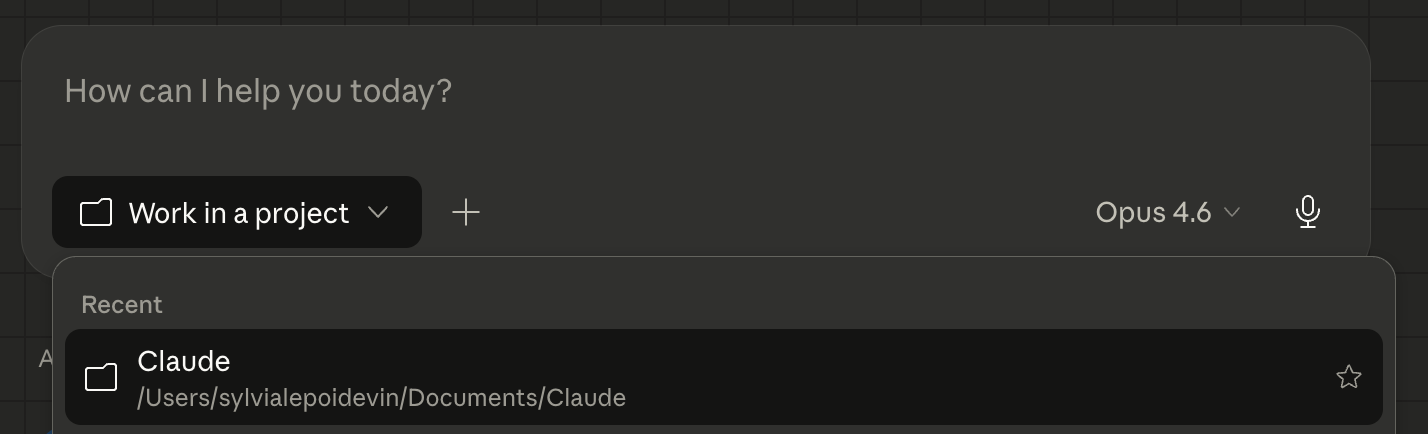
I checked the folder. There was a new file. I opened it with preview. It had a clean summary of everything Claude needed to know about my brand in order to do good work.
And unlike ChatGPT’s memory, I could read it, I could edit it, I could make it whatever I wanted.
Pretty cool.
Connectors and the first mind-blown moment
The next unlock was connectors. I was still in the Claude desktop app, still using Cowork. I went into settings and saw a bunch of connectors. I connected a ton of them.
Email, calendar, project management, call transcripts. No API keys. Just hitting sign in for each one. Easy.
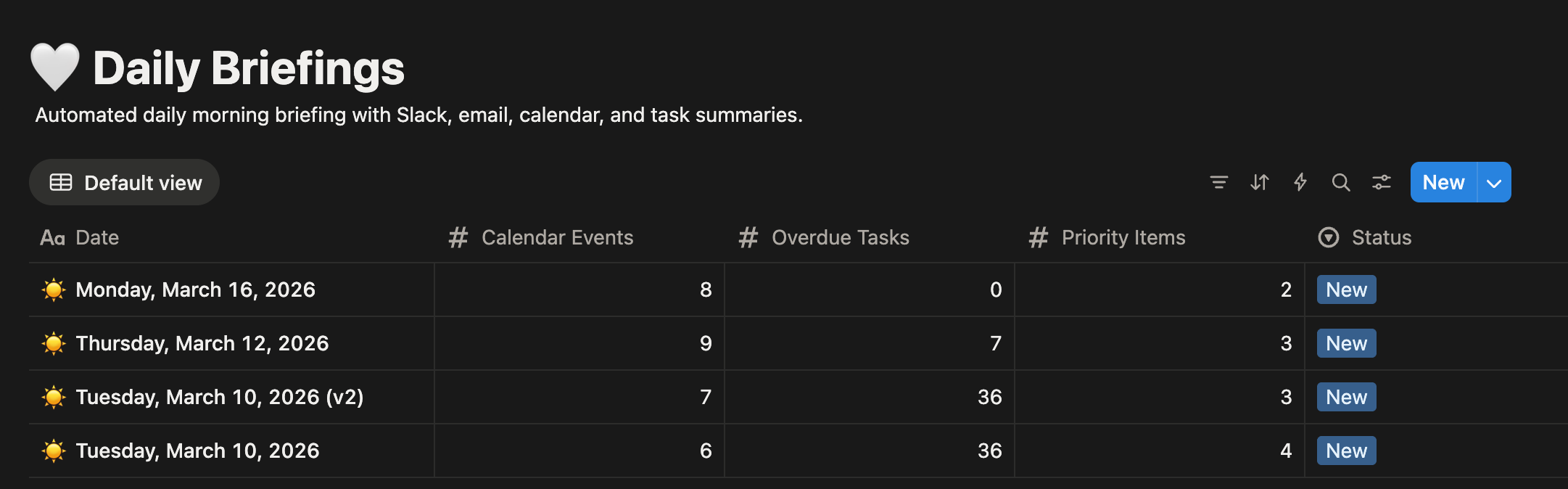
Then I asked Claude something I’d never been able to ask an AI before: write me a briefing for today. What urgent things need my attention.
It did. This task is past due. This person has been waiting for a response for days. Here’s your calendar for today with gaps between meetings mapped to your priority work.
My mind was blown.
I told it to make a Notion database for daily briefings and create a new page in there for each daily briefing.
And it did that.
When it fell apart again
Then I tried to have it write a webpage.
The copy was way too literal. I gave it feedback explaining why a certain line needed to change, and instead of understanding the note and adjusting, it used my exact feedback as the new webpage copy. Just... pasted my feedback in there as if that was the headline.
I felt like I was back to square one. How is this supposed to help me if it can’t even draft something half decent? And I had given it great background info.
Skills changed everything
That’s when I discovered skills.
Skills are like the instructions for a custom GPT. But instead of those instructions only being usable inside that little container of a custom GPT, Claude can pull in a skill anytime, anywhere. You can be in the middle of a conversation about something totally different and it will just realize it needs a certain skill and pull it in. You can take a skill and hand it to someone else and they can use it too.
I made a writing skill. The copy it produced was totally different. Way better. I’d say that sometimes Cowork even with a great writing skill isn’t quite as good as chat. But it’s pretty damn good.
Then I had a realization that blew my mind again. I could make a skill that uses other skills.
I built a product release skill. It knew what assets to execute for every launch: blog, social post, email to customers, community post. But it didn’t need to know how to write. It would pull in the writing skill to actually create each asset. A system of instructions that compound on each other.
Scheduling and the revenge moment
Then I discovered scheduling.
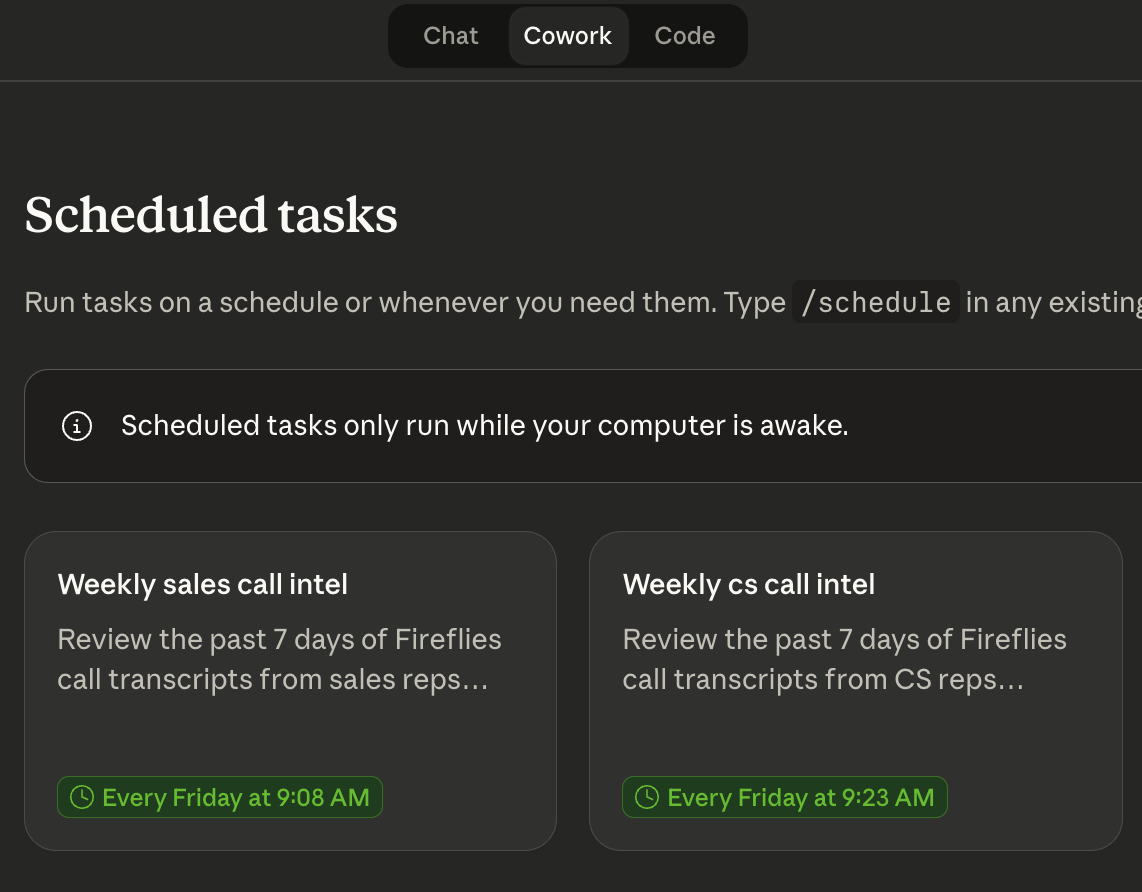
I scheduled that daily briefing to send me a Slack message every morning. I had it read my calendar, see what meetings I had, look at the gaps between them, and map out what I needed to do and when.
Then I scheduled something else: read every sales call we had last week and send me a Slack message breaking down anything important I should know as a marketing leader.
Not a super detailed prompt. The output was excellent. Every Friday morning I’d get a synthesis of that week’s calls. I updated it to send the notification to my whole team in our team slack so we could all benefit from it.
I was on fire.
The exact problem that had broken me on that Monday night, manually synthesizing call transcripts one by one, was now automated and running for my entire team without me touching it.
Opening the terminal
I still didn’t get Claude Code. The actual terminal.
I had read some setup articles on Substack. They talked about the terminal. I also noticed there was a code tab on the Claude desktop app that looked pretty similar to Cowork. So I asked a few people I trusted: what’s the difference?
They all said the same thing. “It’s just better.” “It has more access to stuff on your laptop.”
I was like, I don’t get it. Most of the work I’m doing doesn’t require any more access to my device. I tried the code tab in the desktop app and it seemed basically the same as Cowork.
But everyone kept insisting. So I opened terminal.
It looked like shit.
I found a setup guide from Cannonball GTM and started running through the steps. Ran into a bunch of bugs. Spent maybe 30 minutes debugging, trying to figure out what the hell it means by zsh and bash and staring at a lot of scary looking squiggly lines.
I was not sold.
Ghostty and feeling kind of cool
Then I listened to a Marketing Against the Grain episode, “Claude Code: Landing Page to Lead Magnet in 50 Minutes” with James, the Boring Marketer.
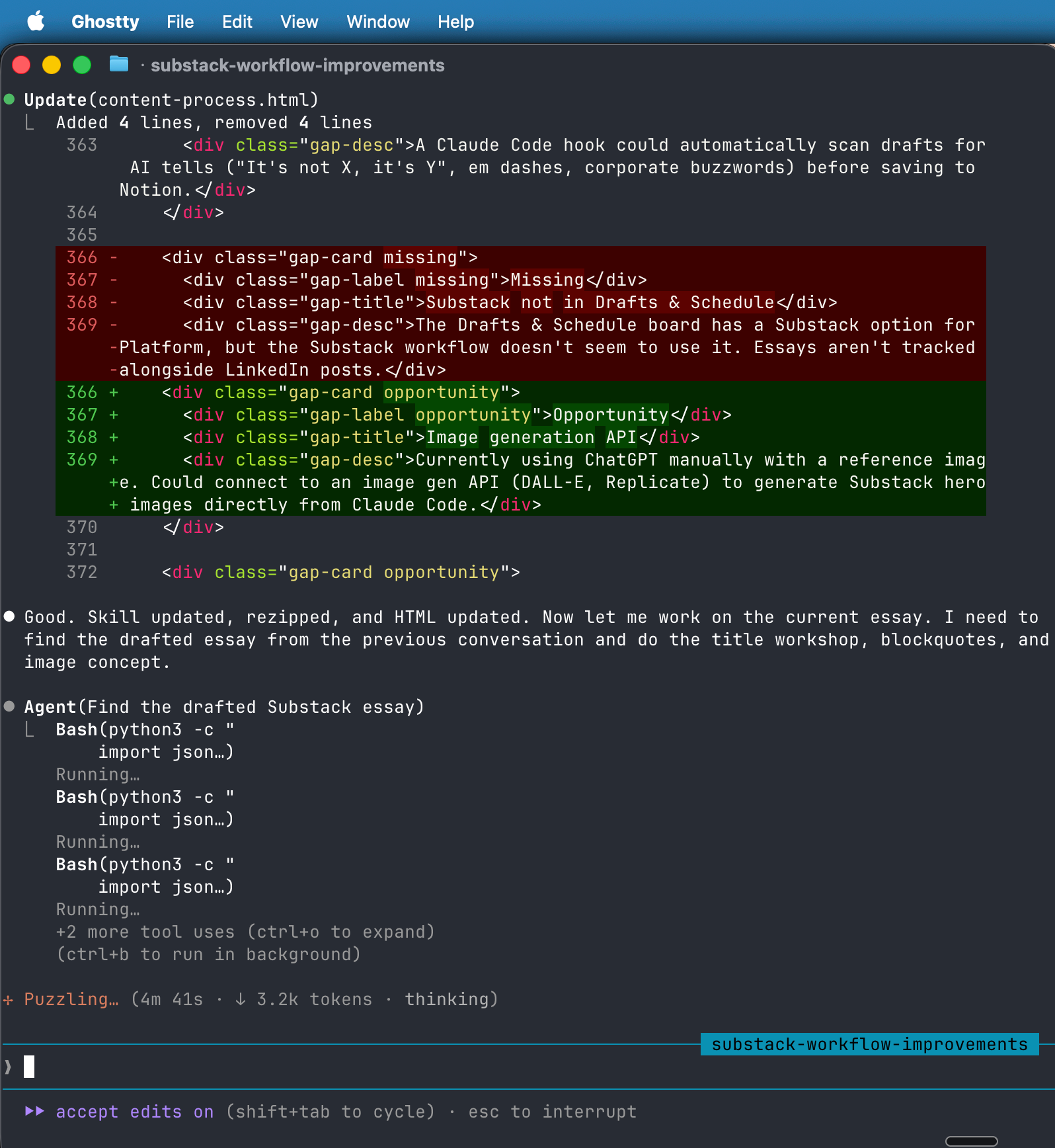
He mentions in passing that he uses something called Ghostty as his terminal app.
Wait. There’s other apps for terminal?
Turns out it makes it look less confusing. Still code-y, but simpler. I installed it. Asked Claude something random. It wrote back.
I felt kind of cool.
Firecrawl, skills from strangers, and HTML magic
James also mentioned something called the Firecrawl plugin for web research.
I tried asking Claude to do some online research first without it, find top influencers in a certain category. It couldn’t pull anything from recent social like LinkedIn.
So I installed Firecrawl. Tried again.
It created an entire Notion tracking board with so much data. Complete with top influencers, their follower counts across every social platform, topics they talk about, and things like potential warm intros and mutual connections.
Then James mentioned you can find skills other people have made and use them.
He had built one called “direct response copy” by researching all the great copywriters: Schwartz, Hopkins, Ogilvy, Halbert, Caples, Sugarman, Collier. I found it on GitHub and downloaded it. Used it on the website copy I’d been struggling with.
Insane upgrade. Great for headlines, subject lines, hooks, anything where you need to grab someone.
Then one more discovery. That campaign strategy I was working on in my second terminal window.
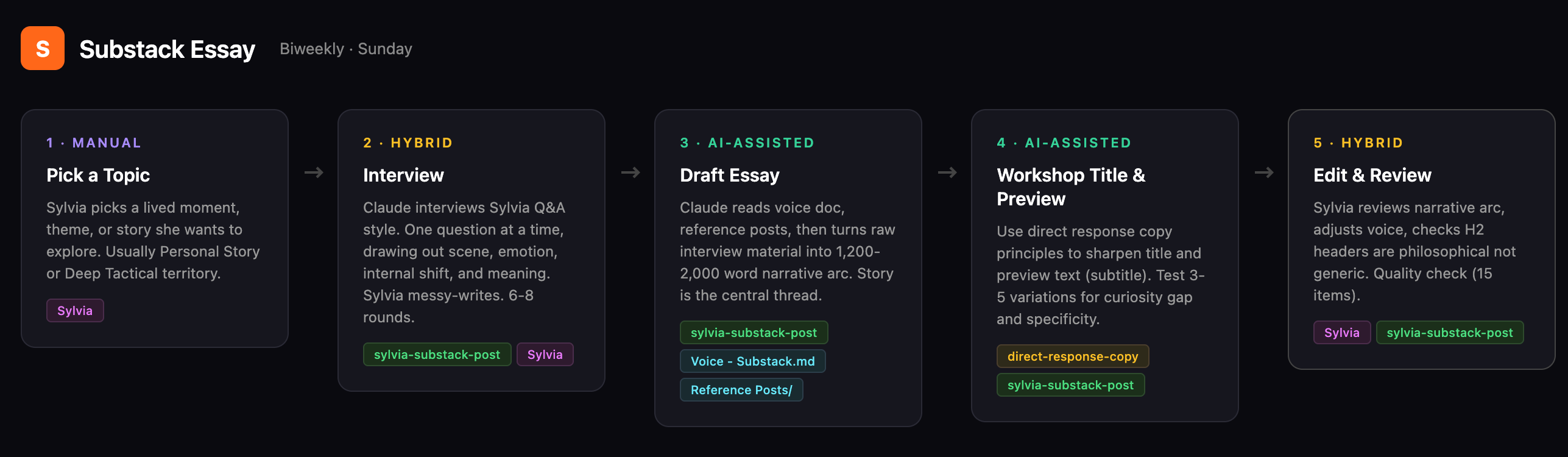
I realized I could ask Claude to make me an HTML visualization of the workflow. It laid out the entire campaign beautifully so I could present it to the team and walk away with a clear strategy we were all aligned on.
Example visual from my living, breathing Substack writing workflow:
Back on the flight
Two weeks after that Monday night, I was sitting in an exit row aisle seat at 7 AM, surrounded by people watching TV and scrolling their phones.
And I had 3 terminal windows open. Building a website. Strategizing a campaign. Creating a system that would turn my weekly conversations into content ideas and cross-reference them against what’s trending in my network.
The same person who had been copy-pasting transcripts one by one into a custom GPT was now running 3 AI workflows in parallel on a flight to a marketing retreat.
All 3 were working toward something bigger than the individual project.
They were making me into the builder I had left my last job to become.
You have to slow down to speed up
That angry Monday, that “unproductive” Tuesday, and the messy week that followed, was the most valuable time I’ve spent in years.
I didn’t learn AI from a course or a masterclass. I learned it by clearing my calendar, accepting I had no idea what I was doing, and just building. Badly at first. Then less badly. Then well enough to feel like a different person.
Anyone can do this. Terminal is not that scary. You kind of feel like a badass once you’re in there.
And Cowork is still the best place to start.
Start with Cowork.
Install connectors.
Build a claude.md file so it actually knows who you are.
Make your first skill.
Schedule something. Get one thing running without you.
Then open the terminal. Install Ghostty so it looks less terrifying.
Try Firecrawl.
Find a skill someone else made.
Ask it to make you something visual.
You’ll feel kind of cool.
And somewhere between that Monday night and that Tuesday morning, between throwing my phone across the room and watching the sun come in over Biscayne Bay, I realized the gap was never about talent or technical ability.
It was about giving myself permission to be bad at something long enough to get good at it.